

On not writing:
Is this a necessary fallow period, or am I just discouraged and lazy?

“How’s the writing going?” my writer friend asks. I do not like this question. I know she’s working away on her book; we discuss her progress on our weekly Zoom calls. But I don’t want to reply to her query. She knows the answer.
I’m writing, yes: a blog maybe once a week, every so often posts on FB and IG and sending out this Substack and a Mailchimp newsletter. I’ve had two letters to the Editor of the Toronto Star published recently, of the four I’ve crafted and sent, and also an Op-ed essay. I’ve written emails of praise or complaint to various places, including yesterday to the CBC protesting an insensitive interviewer. I respond, often instantly, to the scores of emails that pour in.
I’ve been editing clients’ manuscripts and doing workshops, classes, and webinars on memoir writing.
But I’m not working on the next book, the one about how I survived my upbringing with parents both spectacular and impossible. Why am I stuck? Why have I been stuck for over a year?
My last book, the memoir-in-essays Midlife Solo, was launched in early 2024. A lot of time and effort went into trying to get that book noticed — speaking engagements, posting and boasting on social media, tracking down book clubs, urging readers to recommend to friends etc. — marketing chores every writer has to embark on these days. The book has had stellar reviews from readers — 91% five-star reviews on Goodreads — but these have not translated into books flying off shelves. Despite my efforts and the enthusiasm of the few who’ve read it, sales have been slow.
As were the sales for my first book, a hefty biography, and two previous memoirs. The only book of mine that has done fairly well, and that in a limited way, is True to Life, the textbook for my writing courses. How-to books are easier to sell.
So, my internal monologue says, why go to the enormous effort of writing a new memoir that almost no one will read? Good question, no?
Especially because there’s been discouragement in other ways. Recently I worked hard on a longform essay that meant a great deal to me; it told of finding out, long after her death, about an abortion my mother had when young; of the difficult choices countless women, including me, have had to make. The piece was edited by a few clear-eyed writer friends and an actual editor before I entered it in a prestigious Canadian personal essay competition. Six months later I received word: thanks but no thanks. And shortly thereafter read that the competition longlist consists of fifteen essays. Fifteen essays on the longlist, but not mine.
It was like a body blow. I know competitions are subjective, about personal taste. People whose honesty I trust said my essay is powerful and moving, but obviously it was vetted by someone who didn’t like it, perhaps didn’t like the subject matter or my style, plain language with few similes and metaphors, no prize-winning flourishes. I’ve noted before, with other rejections, that my style is not appreciated by competitions.
Does this sound like self-pity? I’m sure it does, and I apologize. My job does not involve going to work at dawn to flip burgers or sit in a cubicle or drive a bus. My job is sitting at home in my sweats thinking and scribbling and revising, and then trying to interest readers. There’s a lot of competition out there for people’s eyes and minds.
I wrote once that finishing the manuscript of a book is like climbing a mountain and arriving, filthy and exhausted, at the summit, to be confronted with a long series of closed doors. The job is to knock on those doors, persuade them to open, keep shoving and pounding, often for many months, until at last one opens. Some are good at this pushy, confidence-wrecking part of the job, and some, like me, are most emphatically not.
And in the end possibly no door opens. The options are self-publishing, or putting that manuscript away and starting another. That also is the job.
But I realize there’s something else getting in the way of my focus — the current desperate state of our world. I’ve lived through bad times before: the Cuban missile crisis, the Vietnam war, the reigns of the vile, destructive Canadian politicians Stephen Harper and Mike Harris. But nothing, nothing like where we are today, with the complete disintegration of the rule of law to the south, the rise of fascism, the celebration of racism, sexism, misogyny, cruelty, selfishness, greed, and worse. Daily witnessing the slaughter of the innocents in Ukraine and Gaza and elsewhere. Wildfires, floods, and extinctions, the planet erupting due to the climate catastrophe.
All that, daily in my inbox, and in yours.
So sitting at a desk, probing memories — how does that help? Is writing memoir a self- indulgent waste of time when I should be doing something, anything, more useful?
But wait. I teach that memoir matters because when it’s well done, it touches something universal in us all; about us all. Homo sapiens are narrative animals; we need stories. We writers tell our stories for those who do not.
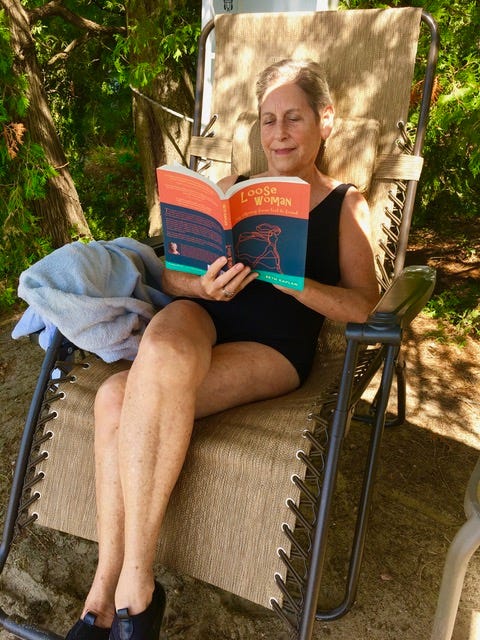
And I need to remind myself that support for my own stories does appear unexpectedly. Only a few weeks ago, a journalist with a celebrated podcast emailed that she’d discovered Loose Woman at a second-hand bookstore; it spoke profoundly to her about dealing with life’s big changes, and she wanted to interview me for her podcast. That memoir, published in 2020, raised my hopes when it was a finalist for an independent book award, but it didn’t win, and the book sank. Now, five years later, an important reader. Jaw-dropping. It happens.
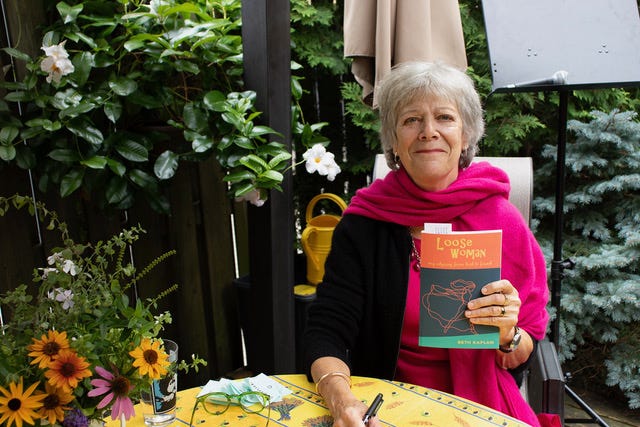
People write to me regularly about an essay or book that reminds them of their own lives. A recent connection made me cry: a B.C. woman read my essay about a childhood best friend I’d lost touch with and searched for in vain, and wrote to tell me she’d known my friend at the end of her life and would be happy to tell me about her. We had a long talk on the phone, and my anguish was put to rest. A huge gift. One of many, as a result of what I do.
Dear readers, I guess we writers keep at this crazy work because it’s what we must do, because it’s who we are. I started writing at the age of six and assume that I’ll keep translating my thoughts to words on a page until death or disability stop my hand. Yes, it can be hard to keep going without a breakthrough or the attention of an agent or winning an award or even a sense of the book-buying world’s general approval. It does give a boost when someone out there signals appreciation.
But in the end, appreciation or not, we do what we do. The work will be there after we die. Who knows where in future it will land, what it will mean?
And so it’s sure that soon, very soon, I’ll go up to my office and begin that book. I will start to climb the mountain. Maybe this last year has been a rest period, storing up strength for the journey. Or maybe it’s just been procrastination and cowardice.
Whatever; it will end. Yesterday, crossing my fingers, I sent the rejected essay to a fine literary magazine that has published me twice. And right now, I’ve spent much of this overcast Saturday sitting in my kitchen, the sleeping cat at my feet, writing and rewriting, figuring out what to say and how to say it.
So here it is, my gift to you. I thank you for your gift to me — your eyes on the words. This is our bond, our covenant with each other.
Onward.
Such a courageous piece Beth. And it's important for you to know that for those of us who have been under your tutelage, even if only for a short time, that your impact on us is profound and that you make such a positive and important
difference in this broken world. With so much respect and appreciation, Jill
Thank you for writing this, Beth. Your words really resonated with me and encouraged me as well. I too struggle with the current situation in our world and the cruel nightmare we are living in here in the U.S. But stories do matter, as you have rediscovered, and we must write because it’s what we do. Who knows the impact a powerful essay can have, especially in these times. By the way, I also dislike being asked “How’s the writing going?”